
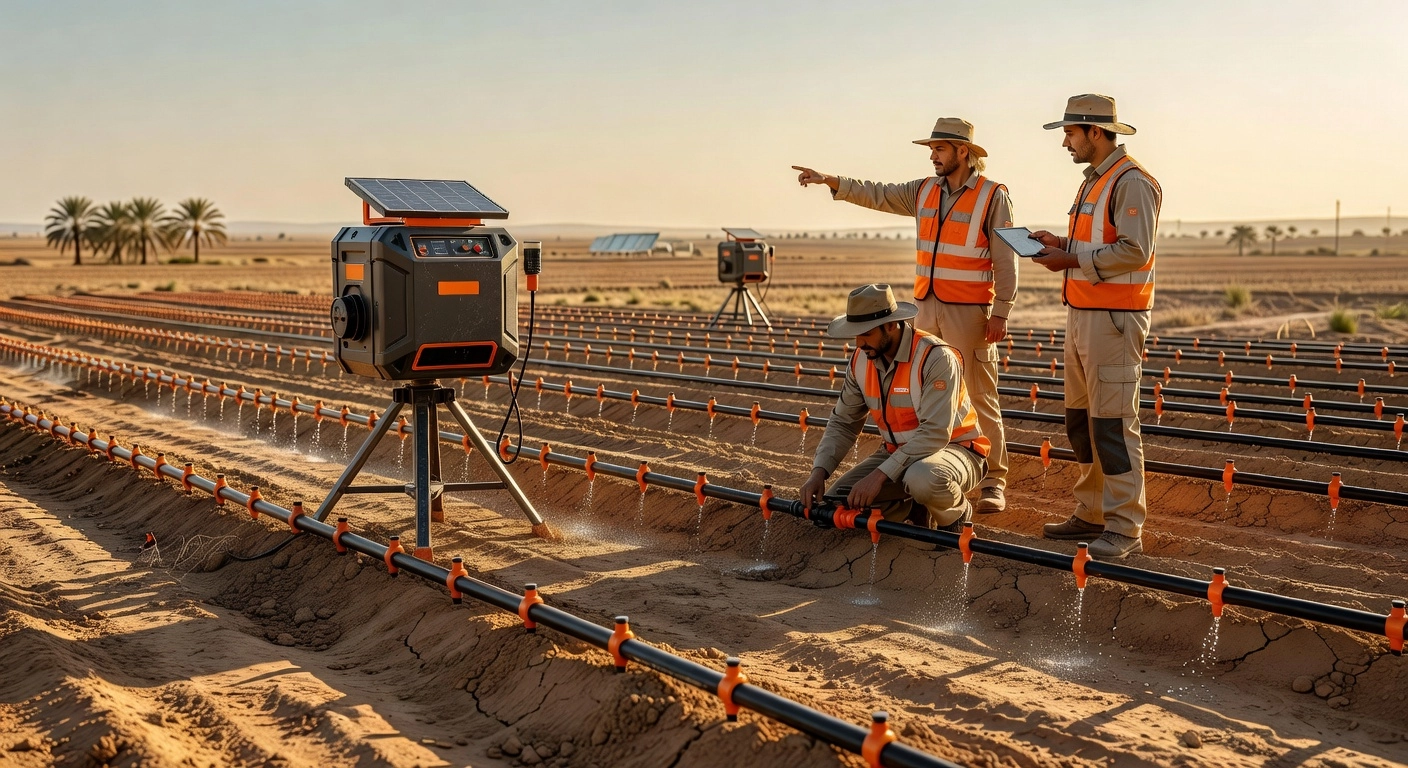
Water scarcity is not a future problem for the MENA region. It is an immediate crisis reshaping how governments, agronomists, and farmers think about food production. With less than 1% of the world's renewable freshwater resources serving nearly 6% of the global population, the pressure to produce more with less has never been greater.
This is precisely where the smart farming drip irrigation system has emerged as a transformative solution. By combining precision water delivery with sensor technology, automation, and real-time data analytics, these systems are redefining agricultural efficiency across some of the world's most arid landscapes.
In this analysis, we will examine how smart drip irrigation technology is being adopted across MENA agriculture, what measurable outcomes farmers and agribusinesses are actually achieving, and which technical and economic factors determine successful implementation. We will also address the challenges that remain, including infrastructure gaps, upfront costs, and the learning curve for smallholder farmers. Whether you are an agricultural professional, an investor, or a policy advisor, this breakdown will give you a grounded, evidence-based perspective on where this technology stands today.
The Water Crisis Driving Smart Irrigation Demand Across MENA
The MENA region holds less than 1% of global renewable freshwater resources while simultaneously supporting approximately 6% of the world's population and rapidly expanding agricultural sectors across the UAE, Kingdom of Saudi Arabia, and Oman. Gulf states routinely import more than 80% of their food supply, yet national ambitions to reduce this dependency are driving intensive domestic cultivation programs in some of the planet's most water-stressed environments. This structural contradiction, extreme aridity paired with growing agricultural ambition, has made smart farming drip irrigation systems not a luxury upgrade but a fundamental operational necessity for any commercially viable agricultural enterprise in the region.
The inefficiency of conventional irrigation methods compounds this challenge severely. Traditional flood and sprinkler irrigation systems lose between 40% and 60% of applied water to evaporation, surface runoff, and deep percolation before it ever reaches the root zone. In hyper-arid climates where summer temperatures routinely exceed 40°C, sprinkler systems suffer additional evaporative losses during peak daylight hours, rendering them particularly wasteful. Drip and micro-irrigation systems, by contrast, achieve application efficiencies of 90% to 95% by delivering water directly to the plant root zone. Research tracking MENA drip irrigation adoption confirms documented water savings of up to 40% in commercial deployments, a figure that carries enormous strategic weight in a region where agriculture accounts for 70% to 90% of total water withdrawals.
Government policy has decisively accelerated this transition. Saudi Vision 2030 places water security at the core of national infrastructure strategy, with the Saudi Water Authority administering subsidies of up to 75% through the Agricultural Development Fund for farms adopting modern precision irrigation equipment. The UAE Water Security Strategy 2036 and the "We the UAE 2031" vision further institutionalize this priority, tying agricultural funding approvals and compliance frameworks directly to sustainable water use practices. For institutional buyers, precision water management has shifted from a cost optimization consideration to a formal compliance and funding eligibility requirement.
The commercial opportunity this crisis is generating is substantial and accelerating. The MENA drip irrigation systems market is estimated at approximately USD 424 million in 2026 and is projected to reach USD 1.4 billion by 2033, representing an 18.6% compound annual growth rate. This expansion significantly outpaces global drip irrigation market growth averages, which typically range between 9% and 11% CAGR, underscoring how urgency, policy support, and capital investment are combining to produce an outsized regional demand curve that suppliers and agricultural operators must position themselves to meet.
What Is a Smart Farming Drip Irrigation System
A smart farming drip irrigation system represents the convergence of two distinct technological domains: the proven physical infrastructure of micro-drip water delivery and the real-time intelligence of connected agricultural technology. At its core, the system integrates IoT soil moisture sensors, AI-driven scheduling controllers, live weather data feeds, and cloud connectivity to create a fully automated, data-optimized water management architecture. Rather than operating on fixed timers or manual operator decisions, these systems continuously read actual field conditions and make dynamic adjustments that align water delivery precisely with crop demand at any given moment.
The Physical Infrastructure Layer
The hardware foundation of a commercial smart drip system is engineered for durability and precision at agricultural scale. Drip emitters and inline drippers deliver water in slow, targeted volumes directly to plant root zones, eliminating the runoff and evaporation losses that plague traditional overhead or flood irrigation. UV-resistant lateral piping is a critical specification for MENA deployments, where prolonged exposure to intense solar radiation and extreme heat degrades standard tubing rapidly, compromising system integrity over multi-season operations. Supporting this network are pressure regulators that maintain consistent flow rates across long field runs, and filtration units that prevent mineral deposits and organic matter from clogging emitter orifices. Mainline supply infrastructure ties these components together at commercial scale, ensuring uniform pressure distribution across large plot areas.
The Intelligence and Automation Layer
The distinguishing capability of a smart system lies in its sensing and control architecture. Soil moisture and temperature sensors are placed directly at root zones, feeding continuous data to automated valve controllers that open and close irrigation circuits based on pre-set thresholds or AI-generated recommendations. Edge computing units installed at field level process sensor inputs locally, reducing latency in automated responses without depending on uninterrupted cloud connectivity. According to peer-reviewed research published in Scientific Reports, this layered sensor-to-controller architecture produces measurably superior water-use efficiency compared to schedule-based systems, with AI models further refining performance by incorporating evapotranspiration rates and forecast weather data. Cloud dashboards accessible via desktop or mobile interfaces give operations managers full visibility into system status, scheduled cycles, and consumption analytics from any location.
Solar-Powered Variants and Off-Grid Adoption
In off-grid MENA agricultural zones where grid electricity is expensive or unavailable, solar-powered drip systems are rapidly gaining adoption. ICARDA research focused on ultra-low-energy drip irrigation for water-scarce regions demonstrates up to 50% energy reduction compared to conventional grid-powered pump-and-distribute systems. This energy efficiency improvement directly reduces operational costs for smallholders and commercial operators alike, making precision irrigation economically viable in contexts where it was previously impractical. Solar integration also aligns with regional sustainability mandates across the UAE and Saudi Arabia, where national programs are actively incentivizing low-carbon agricultural infrastructure.
Multi-Farm Cloud Monitoring at Scale
Cloud connectivity elevates smart drip irrigation from a single-field tool to an enterprise-scale farm management platform. Operations managers overseeing geographically distributed plots can monitor real-time water consumption, system pressure readings, flow rates, and scheduled irrigation cycles from a unified dashboard. Automated alerts flag anomalies such as pressure drops, potential line failures, or sensor threshold breaches before they escalate into crop-damaging events. This centralized visibility is particularly valuable for institutional agricultural operators across the MENA region, where farms may be separated by significant distances but managed by a single operations team. Souq Al Mena's cloud-connected water management systems, supplied through its institutional B2B irrigation desk, are engineered specifically to support this multi-farm monitoring capability in hyper-arid commercial environments.
Smart Drip Irrigation vs. Traditional Methods: A Practical Comparison
Traditional flood irrigation remains the most widely practiced method across MENA agricultural holdings, yet its operational inefficiencies are difficult to overstate. Water applied across entire field surfaces through gravity-fed channels or furrow systems achieves effective delivery efficiencies of only 40 to 60 percent, meaning nearly half of every applied volume disappears through deep percolation below the root zone, surface runoff, or direct evaporation. Repeated irrigation cycles without adequate drainage management progressively mobilize dissolved salts, elevating root-zone salinity and sodicity over multi-year periods in ways that degrade soil structure and require costly remediation. Uneven water distribution across varying topographies and soil textures creates inconsistent crop hydration, with plants at field margins or elevated positions experiencing moisture stress while low-lying zones receive excess. The cumulative result is suppressed yield consistency, accelerating groundwater depletion, and long-term productivity decline across some of the world's most water-stressed farmland.
Conventional drip systems without smart controls represent a meaningful step forward in delivery efficiency, achieving application rates above 90 percent by targeting water directly to root zones. However, fixed-timer or manual-schedule operation introduces a different category of inefficiency. A system programmed to irrigate at set intervals has no mechanism to account for a sudden temperature drop, an unexpected rainfall event, or a mid-afternoon heat spike exceeding forecasted conditions. The practical consequence is over-irrigation during cooler or wetter periods, which leaches nutrients, risks waterlogging, and wastes treated water; and under-irrigation during peak heat events, which induces plant stress and directly suppresses yield at precisely the moments crops need optimal hydration. According to comparative analysis of drip versus traditional irrigation systems, this scheduling mismatch consistently limits the water-use efficiency gains that the physical drip infrastructure is otherwise capable of delivering.
Smart farming drip irrigation systems close this gap by integrating soil moisture sensors, real-time weather data feeds, and AI-driven controllers that dynamically recalculate scheduling every few minutes rather than every few days. MENA smart irrigation market research documents water application reductions of 30 to 50 percent versus conventional drip lines in regional field deployments, with specific cases including a 35 percent reduction in Saudi date palm cultivation and a documented 40 percent saving in Dubai's Sustainable City implementation. These figures are not theoretical; they reflect compounding gains from eliminating over-irrigation events, reducing evaporation during non-optimal application windows, and maintaining precise volumetric soil moisture targets throughout growing cycles.
The labor dimension of this comparison carries significant operational weight. Flood and conventional drip systems both demand frequent manual field checks, valve adjustments, and schedule modifications that scale in time and cost as farm area grows. Smart controllers shift this workload to exception-based management, where agronomists monitor dashboards remotely and intervene only when sensor alerts flag anomalies such as pressure drops, emitter blockages, or unexpected moisture deficits. IoT and AI-driven systems consistently reduce operational labor by 20 to 30 percent in commercial agricultural contexts, according to farm irrigation technology assessments, freeing resources for higher-value crop management activities.
Total cost of ownership analysis ultimately determines adoption decisions for commercial operators. Smart system upfront costs, including sensors, controllers, cloud connectivity, and installation, typically range from USD 2,000 to USD 10,000 per hectare depending on configuration and scale. These figures are substantially higher than flood infrastructure. However, compounded savings across water consumption, energy for pumping, fertilizer application, and labor begin generating positive returns within three to five years for operations exceeding two to three hectares. In GCC countries, where water tariff trajectories are rising in direct response to groundwater depletion pressures and national sustainability mandates, the payback window is shortening further. Sovereign subsidy programs reaching up to 70 percent of installation costs in some jurisdictions, combined with Vision 2030-aligned agritech investment frameworks, are materially accelerating the financial case for smart drip adoption across commercial-scale MENA agriculture.
Quantified ROI: Water, Energy, and Labor Savings in MENA Operations
The financial case for deploying a smart farming drip irrigation system across MENA operations is no longer theoretical. Documented field performance data from Dubai, peer-reviewed ICARDA research, and regional case studies now provide commercial growers and institutional buyers with concrete ROI benchmarks across four measurable dimensions: water, energy, labor, and yield.
Water Cost Reductions Reaching 40% in UAE Deployments
Smart irrigation deployments in Dubai have achieved documented water savings of up to 40% relative to baseline consumption, a figure with direct financial implications for farms operating under metered municipal allocations or licensed groundwater extraction quotas. At the commercial scale, drip emitters achieving 90 to 95% application efficiency eliminate the evaporative and runoff losses inherent to flood and sprinkler methods. For farms procuring water at regulated UAE tariff rates, a 40% volume reduction translates proportionally into procurement cost savings that compound annually across the irrigation season.
Energy Efficiency Gains Validated by ICARDA Field Research
ICARDA's Ultra-Low Energy Drip Irrigation program, conducted specifically across MENA arid-zone field sites including the UAE, Kuwait, Qatar, Morocco, and Jordan, demonstrated hydraulic energy reductions of 46 to 69% per unit of water delivered through ultra-low-pressure emitter configurations activated at approximately 0.15 bar. When paired with solar-powered pump units, total energy cost reductions of approximately 50% are achievable relative to conventional diesel or grid-powered pumped systems. This energy savings dimension is particularly significant in MENA markets where pumping costs represent a substantial share of operational expenditure, especially for groundwater-dependent farms drawing from deeper aquifer levels.
Labor Productivity Gains Through IoT Automation
IoT-enabled irrigation platforms consistently produce labor cost reductions of 20 to 30% across commercial deployments. Automated scheduling algorithms, remote valve actuation, and real-time anomaly alerts eliminate the need for continuous manual field monitoring, reduce on-site staffing requirements, and allow farm managers to supervise larger irrigated areas with the same personnel resources. In larger operations, this includes measurable reductions in staff hours dedicated to valve operation, soil scouting, and emergency leak response.
Fertigation Integration and Yield Outcomes
Precision root-zone water delivery directly reduces crop stress and improves moisture uniformity across the growing canopy. When fertigation channels are integrated into smart drip lines, nutrient delivery becomes synchronized with actual plant demand, reducing fertilizer waste, limiting soil amendment leaching, and improving nutrient uptake efficiency. Field studies across MENA precision agriculture trials report yield improvements of 20 to 50% versus conventional irrigation methods, with some IoT-assisted deployments recording gains approaching 43% alongside simultaneous water reductions.
Market Growth Confirming Commercial ROI Recognition
The global irrigation automation market is expanding at approximately 16% CAGR, a trajectory that directly reflects accelerating commercial farm recognition that automation payback periods, typically two to five years depending on water and energy pricing, fit within standard agricultural capital investment cycles. Souq Al Mena's cloud-connected water management systems and commercial drip infrastructure are positioned to serve this growing regional demand, supplying the hardware layer that makes quantified efficiency gains achievable for MENA institutional buyers and commercial growers.
MENA Market Momentum and Government Policy Alignment
The market data surrounding smart farming drip irrigation systems in MENA tells a compelling story of structural, policy-driven expansion rather than speculative growth. The MENA drip irrigation systems market is valued at approximately USD 424 million in 2026 and is projected to reach USD 1.4 billion by 2033, compounding at an 18.6% CAGR over that period. That trajectory significantly outpaces global averages, reflecting a region where water scarcity is not an abstract risk but an immediate operational constraint shaping every agricultural investment decision. The agriculture segment anchors this growth, commanding approximately 50% of total market share, as large-scale commercial farms cultivating cereals, vegetables, and cash crops across Saudi Arabia, the UAE, and Egypt convert to drip delivery systems that reduce evaporation losses and maximize root-zone efficiency on sandy, arid soils.
The broader MEA smart irrigation market reinforces this trajectory. Valued at approximately USD 114 million in 2025, the segment is forecast to reach USD 465 million by 2034 at a 16.9% CAGR, according to Market Data Forecast's Middle East and Africa smart irrigation analysis. This parallel growth signal is significant; it confirms that infrastructure investment is expanding beyond physical hardware to include IoT controllers, cloud platforms, and sensor networks, the layered architecture that transforms conventional drip lines into fully integrated smart farming systems.
Government policy is the most consequential accelerant within this market. Saudi Arabia's Vision 2030 has positioned the Ministry of Environment, Water and Agriculture as an active procurement driver, with the Agricultural Development Fund offering 50 to 75% financing coverage for certified modern irrigation deployments. The UAE's National Farm Support Program channels subsidies toward energy-efficient and smart irrigation technologies, with institutional buyers receiving priority access to grants when deploying precision-certified systems. These programs do not merely incentivize adoption; they structurally de-risk capital allocation for commercial operators and cooperatives evaluating system upgrades. According to FAO research on Saudi Arabia's smart irrigation push, alignment between national water strategy and agri-tech procurement is actively reducing groundwater dependency across the Kingdom's agricultural zones.
At the technology level, drip irrigation holds approximately 64% share within global precision irrigation analyses, confirming its dominance as the delivery platform of choice within smart farming infrastructure. Within MENA specifically, inline emitters and pressure-compensating drippers represent the fastest-growing hardware sub-segment, with inline emitters projected to command roughly 65.8% of emitter-type share in 2026. Commercial farms are actively retiring older surface tape configurations in favor of these advanced emitters, which offer superior clog resistance, uniform distribution under variable pressure conditions, and direct compatibility with smart controller integration. This hardware transition is a critical adoption signal for institutional suppliers; it indicates that procurement decisions are increasingly driven by system interoperability requirements rather than unit cost alone.
Emerging Technologies Reshaping Smart Drip Systems in 2026 and Beyond
The technological frontier of smart farming drip irrigation systems is advancing faster than most regional operators anticipated, with five distinct innovations converging to redefine what precision water management looks like across GCC agriculture.
Subsurface drip irrigation (SDI) is broadening well beyond its traditional application in vineyards and orchard crops. Deployments across GCC desert agriculture zones now extend SDI configurations to alfalfa, cotton, and vegetable row crops, where buried emitter lines deliver water and nutrients directly to the root zone, eliminating surface evaporation entirely. Field trials in semiarid conditions have recorded yield improvements exceeding 34% compared to conventional surface methods, while treated wastewater reuse streams, processed to agricultural-grade standards through advanced filtration systems, are increasingly integrated into SDI infrastructure to address chronic freshwater scarcity in the region.
5G connectivity and cloud platform integration are transforming operational scale. Commercial farms spanning hundreds of hectares now deploy multi-sensor IoT networks that stream soil moisture, pressure, flow rate, and temperature data through 5G infrastructure to cloud dashboards processing inputs at sub-minute refresh intervals. Published research frameworks combining 5G with edge-cloud hybrid architectures have documented water savings approaching 45%, with automated alerts flagging leaks, emitter blockages, and pressure anomalies before they translate into yield losses.
Satellite and remote sensing integration removes one of the most persistent bottlenecks in large-scale irrigation management, which is the dependence on manual agronomist scheduling. Platforms now ingest canopy temperature data from thermal satellite bands, NDVI vegetation stress indices from Sentinel and Landsat imagery, and dynamic precipitation forecasts into automated controller logic. As AI-driven irrigation research across MENA demonstrates, these predictive scheduling models trained on regional climate datasets consistently outperform fixed agronomic calendars, particularly where seasonal shamal wind patterns, acute humidity events, and temperature swings create highly variable evapotranspiration dynamics.
Solar-powered smart drip systems represent arguably the most strategically significant deployment category emerging across Oman, KSA interior regions, and remote UAE farms. Photovoltaic module costs falling below USD 0.20 per watt, combined with regional irradiance levels reaching 3,000 kWh per square meter annually, now make off-grid smart irrigation economically compelling. Oman pilot programs integrating IoT controls with solar-powered pump stations have recorded water savings between 25% and 35%, while alignment with KSA Vision 2030 agricultural efficiency mandates is accelerating procurement of these bundled renewable-smart systems across interior farming corridors. Souq Al Mena's industrial irrigation desk supplies UV-resistant piping and cloud-connected management hardware precisely suited to these demanding off-grid deployment conditions.
How to Select the Right Smart Drip Irrigation System for Your Operation
Selecting the right smart farming drip irrigation system begins with an honest assessment of farm scale and crop type, as these two variables cascade into every downstream specification decision. Row crops across large open fields typically require subsurface or surface driplines with higher-flow emitters rated at 1.5 to 2+ liters per hour and spacing of 30 to 45 centimeters to cover broad soil profiles efficiently. Greenhouse horticulture demands the opposite configuration: fine drip tape with closely spaced low-flow emitters at 0.5 to 1.2 liters per hour and intervals as tight as 10 centimeters to maintain precise, uniform moisture in controlled growing environments. Tree orchards and date palm plantations, prevalent across the MENA region, benefit from point-source pressure-compensating emitters placed at multiple positions per root zone, accommodating the wide spacing and slope variability common to orchard layouts. Open-field vegetable production typically performs best with drip tape at 20 to 30 centimeter emitter intervals, adjusted closer on sandy soils where lateral water movement is limited.
Water source quality is the second critical filter in the selection process, and operators drawing from brackish groundwater, treated municipal wastewater, or high-sediment irrigation canals face meaningfully higher system risk if this factor is underweighted. Saline or sediment-laden water accelerates emitter clogging, degrades standard polyethylene components, and introduces crop safety hazards if untreated. These conditions demand multi-stage filtration assemblies combining sand media filters, disc filters, and screen filters, paired with corrosion-resistant piping rated for saline exposure. Chemical injection ports for scale inhibitors should also be incorporated into the system design from the outset rather than retrofitted later.
Connectivity infrastructure at the farm site determines the appropriate controller architecture. Operations with stable cellular or broadband access can leverage fully cloud-connected platforms offering remote monitoring, AI-driven scheduling adjustments, and centralized data dashboards. Remote or off-grid locations are better served by solar-powered edge-computing controllers with GSM or LoRa connectivity, which operate autonomously using local sensor data while periodically syncing with cloud platforms when signal permits.
Budget planning should follow a structured three-tier framework. The infrastructure layer, covering piping, emitters, filtration assemblies, and pressure regulation valves, represents the largest upfront capital commitment and should not be compromised on material quality. The intelligence layer, encompassing soil moisture sensors, automated controllers, and cloud platform subscriptions, delivers the data-driven optimization that differentiates smart systems from conventional installations. The maintenance provision, typically 10 to 15 percent of annual system value, must cover emitter flushing cycles, sensor recalibration, and filter media replacement to protect long-term performance.
Finally, a compatibility audit of existing pumping infrastructure, fertigation injectors, and any legacy scheduling hardware should precede any procurement decision. Mismatched pump pressure ratings, incompatible fertigation injector protocols, or outdated valve actuators can generate integration costs that substantially erode projected ROI timelines. Souq Al Mena's commercial irrigation desk structures pre-sale consultations around exactly this audit process, ensuring that the cloud-connected drip systems and UV-resistant piping it supplies integrate cleanly with each buyer's existing water infrastructure before a single component is shipped.
Why GCC Agricultural Buyers Source Smart Irrigation Systems Through Souq Al Mena
Souq Al Mena operates from the UAE as an institutional B2B supplier purpose-built for the specific procurement demands of GCC agricultural operators. The company's core irrigation offering encompasses commercial agricultural drip lines, UV-resistant piping rated for the high-UV, high-temperature conditions common across Gulf farming environments, and cloud-connected water management systems designed to function reliably in hyper-arid climates. Procurement teams managing large-scale farm projects or government-linked agricultural schemes across the region can engage directly through structured bulk quote channels, gaining access to competitive volume pricing without navigating multiple intermediary layers. This direct engagement model is particularly relevant given that the MENA drip irrigation market is projected to expand from approximately USD 424 million in 2026 to USD 1.4 billion by 2033, a trajectory that places significant pressure on buyers to secure reliable, cost-stable supply relationships now rather than later.
Dual Access Model for Institutional and Commercial Buyers
The company's architecture accommodates two distinct buyer profiles without friction. Institutional procurement teams overseeing large commercial farm installations submit structured bulk quote requests and receive customized pricing aligned to project scale, delivery scheduling, and component specifications. Smaller-scale commercial growers who need to source smart irrigation components without committing to large minimum order quantities can access the souq-mena.com e-commerce platform directly, with full Arabic language support and dynamic multi-currency conversion tailored to the buyer's billing location. This accessibility is meaningful given that direct-to-grower online channels are actively democratizing smart irrigation adoption across the region, enabling mid-tier operators to build out precision systems incrementally rather than waiting for capital-intensive single-phase procurement.
Logistics Infrastructure and Direct-Source Pricing Advantage
Global sourcing routed directly from manufacturers eliminates the broker markups that routinely inflate component costs when procurement moves through indirect distribution chains. Outbound logistics flow through Jebel Ali in Dubai and Khorfakkan in Sharjah, two of the region's most strategically positioned ports for GCC land distribution. Delivery windows of one to twenty-three days cover UAE, KSA, Oman, Bahrain, and Kuwait through established regional land networks, providing predictable lead times that support project scheduling. The water management infrastructure division supplies micro-watering hardware with documented performance achieving up to 40% reduction in water consumption across dry climate deployments, directly supporting farms pursuing compliance with GCC water efficiency benchmarks and positioning operators for government subsidy eligibility under UAE and Saudi Vision-linked agricultural programs.
Procurement Flexibility Without Proprietary Lock-In
Operating as a regional distributor rather than a single-brand manufacturer gives Souq Al Mena a structural advantage that procurement-focused buyers consistently prioritize. Buyers are not constrained to a proprietary product ecosystem, meaning system configurations can be assembled across drip line specifications, emitter types, piping grades, and connectivity modules that match specific crop, soil, and operational requirements. A date palm operation in KSA with sandy loam soil and remote monitoring requirements will specify differently from a greenhouse vegetable producer in Oman managing varied humidity zones, and both buyer profiles can be served with matched component sets through a single regional sourcing relationship. This configuration flexibility, combined with the company's GCC-rooted logistics footprint, positions Souq Al Mena as a practical procurement partner for operators building or scaling smart farming drip irrigation systems across the Gulf.
Key Takeaways for Commercial Farm Operators Evaluating Smart Drip Systems
Smart farming drip irrigation systems have crossed a critical threshold in MENA agriculture, shifting from aspirational technology to commercially validated infrastructure. Documented performance data confirms water savings of up to 40%, energy reductions approaching 50% through solar-powered and ultra-low-pressure configurations, and labor cost decreases of 20 to 30% through IoT-driven automation. These are not projected figures; they reflect operational outcomes from regional deployments already running across arid-climate farms.
The MENA market trajectory from USD 424 million in 2026 to USD 1.4 billion by 2033 at an 18.6% CAGR reflects the convergence of government food security mandates, intensifying water scarcity, and falling hardware costs. Operators who delay procurement decisions are effectively absorbing rising input costs while competitors lock in efficiency gains and government subsidy windows.
Procurement decisions should begin with a structured assessment of farm scale, crop type, water source quality, and connectivity infrastructure before any catalog review. Skipping this sequence produces mismatched hardware selections that underperform against their documented benchmarks.
Regional B2B suppliers with direct manufacturing relationships and established GCC logistics networks deliver measurable procurement advantages over global catalog distributors, particularly for bulk commercial deployments requiring local compliance, customs familiarity, and reliable post-delivery support.
Contact the Souq Al Mena B2B desk directly to request a bulk quote, or explore the smart irrigation catalog at souq-mena.com to evaluate system configurations aligned with your operational scale and agronomic requirements.
Conclusion
Smart farming drip irrigation systems are not a luxury for MENA agriculture; they are a necessity. The evidence is clear: precision irrigation reduces water consumption dramatically, improves crop yields, and delivers measurable returns on investment even in the region's most challenging environments.
Three takeaways stand out. First, sensor-driven automation removes the guesswork from water management. Second, scalable implementation makes these systems viable for smallholders and large agribusinesses alike. Third, the technology is available today, not years from now.
The question is no longer whether to adopt smart irrigation. It is how quickly you can act.
If you are a farmer, agronomist, or agricultural decision-maker in the MENA region, now is the time to evaluate your water strategy. Explore pilot programs, connect with local implementers, and take the first step toward farming that is both sustainable and profitable.