
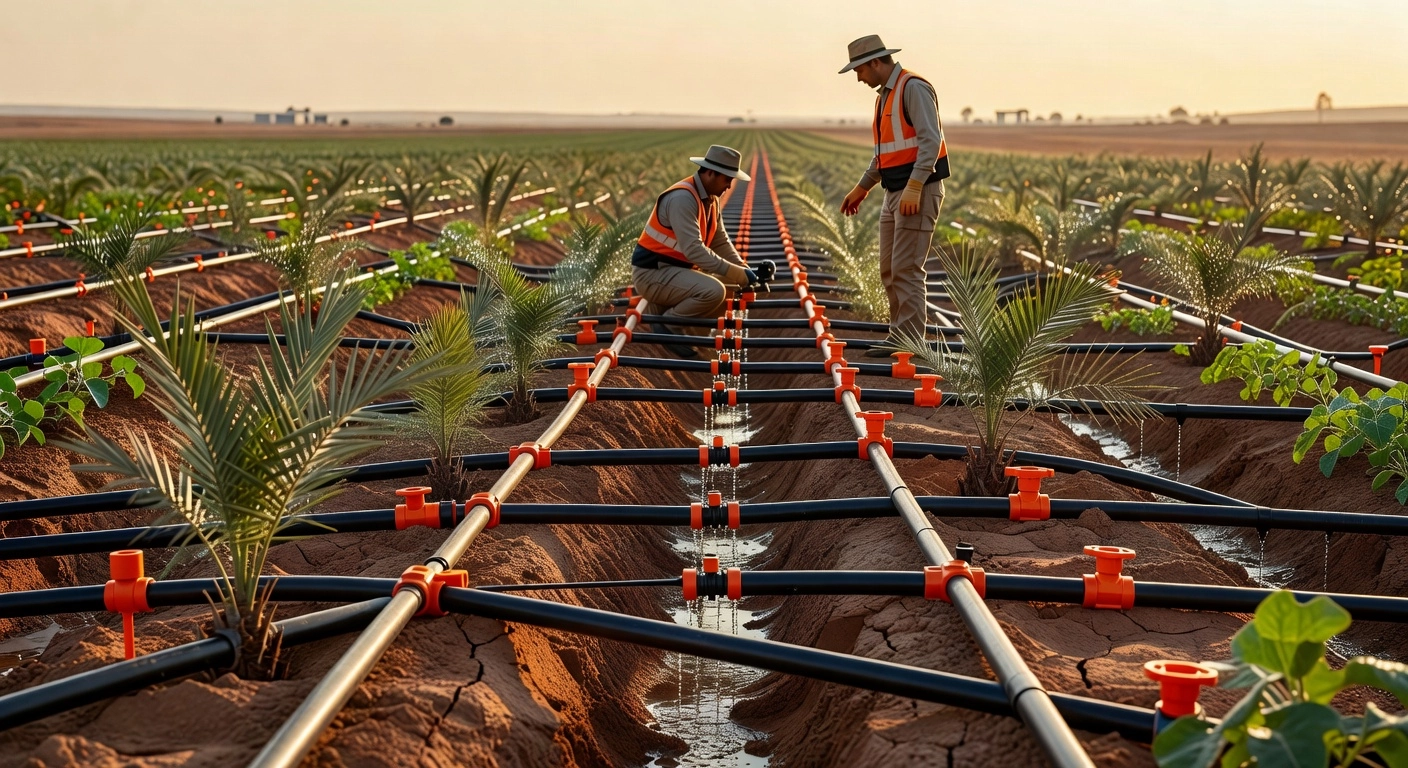
Water scarcity is reshaping agriculture across some of the world's most resource-constrained regions, and the stakes have never been higher for commercial producers. In the MENA region, where arable land is limited and freshwater reserves are under relentless pressure, the choice of irrigation technology is not simply operational; it is existential.
Drip irrigation for commercial farming has emerged as the most compelling solution to this challenge, offering measurable reductions in water consumption while simultaneously improving crop yields and quality. But beyond the environmental case, there is a compelling financial argument that deserves rigorous examination.
This analysis breaks down the real return on investment that commercial farms across the MENA region are achieving with drip systems. You will find a clear-eyed look at upfront infrastructure costs, long-term operational savings, crop yield improvements, and the policy incentives that are accelerating adoption. Whether you are evaluating a first-time installation or scaling an existing system, this piece equips you with the data and framework needed to make a confident, informed decision about one of agriculture's most transformative technologies.
Why Commercial Farms Are Driving the Global Drip Irrigation Shift
Commercial farms have emerged as the undisputed engine of global drip irrigation adoption, accounting for 53.9% of the worldwide market share as of current data. This dominance reflects a fundamental economic reality: large-scale agricultural operations command the financing access, operational scale, and subsidy eligibility required to convert entire field systems from legacy flood or sprinkler methods to precision drip infrastructure. Unlike smallholder plots, commercial enterprises can spread high capital costs across thousands of hectares, compress payback periods to under three years on high-value crops, and absorb the technical complexity of automated fertigation and IoT monitoring.
The broader market signals reinforce this momentum. The global drip irrigation market is valued at approximately USD 10 to 11 billion in 2026 and is projected to reach USD 16 to 29 billion by the early 2030s, expanding at a compound annual growth rate of 9 to 14%. Falling component costs, yield gains of 20 to 40%, and tightening water regulations are converging to accelerate commercial conversions across every major agricultural region.
Nowhere is this pressure more acute than in MENA. The region holds only 1 to 2% of global renewable freshwater resources while sustaining over 6% of the world's population, a structural imbalance with no near-term geographic remedy. Agriculture already consumes between 70 and 90% of all freshwater withdrawn across the region, yet traditional flood irrigation wastes up to 50% of every liter applied through evaporation and runoff. That inefficiency is no longer financially or politically sustainable.
Across GCC markets, a convergence of policy levers is forcing the transition. Water pricing reforms are eliminating long-standing agricultural subsidies on consumption. Saudi Arabia has set a mandatory 40% improvement target in agricultural water-use efficiency under its national strategy, with over 120,000 hectares already converted to smart irrigation systems and government subsidies covering up to 70% of adoption costs. Rising energy and labor input costs further erode the economics of flood methods, making precision drip systems not merely preferable but operationally necessary for commercially viable farming in hyper-arid climates.
The Business Case: Water, Yield, and Labor Returns on Commercial Scale
The financial logic behind drip irrigation commercial farming investment becomes compelling when quantified across its three primary return drivers: water conservation, labor reduction, and yield preservation. Understanding these returns in concrete terms is essential for operators evaluating capital allocation in arid and semi-arid production environments.
Water efficiency sits at the core of the economic argument. Research published in the MDPI Water Journal consistently documents water use reductions of 30-60% compared to conventional surface or furrow irrigation, with precision-optimized and sensor-controlled systems pushing toward or exceeding the upper bound of that range. Application efficiency in drip systems reaches 85-95%, compared to just 50-60% for flood or furrow methods. In GCC contexts specifically, documented savings of 40-60% are achievable across a range of horticultural and row crops. For commercial operators paying rising volumetric water tariffs, or drawing from depleted aquifers, these percentages translate directly into reduced input costs at scale.
Field-level validation reinforces what controlled research suggests. Trials documented by CDFA-affiliated researchers on 11 commercial sweet corn fields in California's Imperial Valley recorded an average 37% reduction in water applied, equating to approximately 2.2 acre-feet conserved per acre, alongside a 5% increase in marketable yield versus furrow-irrigated fields. The yield gain, attributed to consistent root-zone moisture that eliminated plant stress from irregular application, directly refutes the assumption that conservation requires a productivity trade-off. Fertilizer savings of roughly 25% per acre were also recorded, adding a secondary cost reduction layer that compounds the water benefit.
Labor cost reduction represents the third significant return vector on commercial operations. Automation of irrigation scheduling, fertigation dosing, and remote system monitoring enables documented labor savings of 20-30% on large-scale farms. IoT-connected controllers and soil moisture sensors eliminate the need for manual field checks, channel maintenance, and frequent intervention that conventional irrigation demands. On operations spanning hundreds of hectares, this translates into meaningful reductions in permanent and seasonal headcount requirements, with the savings scaling proportionally to farm size.
Fertigation integration amplifies both productivity and economic returns for high-value MENA crops. Soluble nutrients delivered in precisely timed doses directly to the root zone reduce nitrate leaching, improve nutrient uptake efficiency, and demonstrably enhance produce quality in dates, tomatoes, and leafy greens. For export-grade or premium-market produce, quality consistency directly affects realized price per unit, not merely yield volume.
The GCC subsidy environment fundamentally reshapes payback analysis. Market analysis for the MEA smart irrigation sector confirms that government programs in Saudi Arabia cover up to 70% of installation costs, with over 120,000 hectares already supported under national water efficiency mandates. In an unsubsidized market, commercial drip system payback typically falls in the 3-7 year range depending on crop value and water cost. With 70% cost coverage, that window compresses to as little as 1-3 years, producing a risk-adjusted return profile that is difficult for alternative capital deployments to match. Souq Al Mena's commercial irrigation systems are engineered specifically to operate within these subsidy frameworks, delivering the UV-resistant piping, cloud-connected management hardware, and precision emitter technology that GCC agricultural programs require for qualification and compliance.
Commercial Drip System Components Built for Large-Scale Operations
Deploying a high-performance drip irrigation system at commercial scale demands far more than running tubing from a water source to a field. Each component in the network must be engineered to handle the specific physical, chemical, and climatic stresses present across MENA growing regions, where solar radiation is intense, temperatures swing dramatically between day and night, and water quality is frequently compromised by salinity or suspended particulates.
Mainline Infrastructure and UV-Resistant Piping
The backbone of any large commercial system is its mainline piping, and the material specification here carries significant long-term consequences. High-density polyethylene (HDPE) and low-density polyethylene (LDPE) tubing, formulated with carbon black additives, deliver the UV resistance necessary for above-ground installations exposed to relentless desert sun. Unlike softer vinyl alternatives that crack or deform under thermal stress, quality polyethylene pipe maintains structural integrity across the wide diurnal temperature variances typical of Gulf and broader MENA agriculture zones. For commercial blocks spanning hundreds of hectares, mainlines must also resist expansion under sustained heat while maintaining hydraulic performance across long distribution runs.
Pressure-Compensating Emitters for Terrain Variability
On large commercial blocks with undulating or sloped terrain, lateral runs can extend several hundred meters, creating substantial pressure differentials between the inlet and the terminal emitter. Pressure-compensating (PC) drippers incorporate flexible silicone membranes that self-regulate output across wide operating pressure ranges, commonly from 7 to 58 psi, ensuring every plant along the lateral receives a consistent flow rate. This uniformity directly translates to consistent crop development, reduced zones of over-saturation or drought stress, and improved overall yield predictability. For orchards, vineyards, and open-field row crops in particular, PC technology is not a premium upgrade but an operational necessity.
Filtration Systems for High-Salinity and High-Sediment Sources
Water quality in the MENA region frequently presents dual threats: elevated salinity and high particulate loads from surface or groundwater sources. Disc filters, constructed from stacked grooved polypropylene rings, provide depth filtration that captures organic debris and algae throughout the element body rather than just at a surface screen. Screen filters complement this by targeting inorganic sediment such as sand and fine silt. Commercial installations increasingly use automatic backflush disc filter assemblies, which purge accumulated debris on a timed or pressure-differential trigger without interrupting irrigation cycles. Selecting the correct mesh rating, typically between 120 and 200 mesh for drip applications, should be based on a detailed water quality analysis specific to each source. According to MENA drip irrigation market analysis, filtration reliability is among the top procurement criteria for commercial operators in arid regions.
Fertigation Injection for Precision Nutrient Delivery
Fertigation transforms the irrigation network into a precision nutrient delivery system, eliminating the labor and inefficiency of broadcast fertilizer application. Venturi injectors use the pressure differential within the mainline to draw concentrated nutrient solution into the water stream proportionally, offering a mechanically simple and low-maintenance option well-suited for mid-scale commercial operations. For larger, multi-zone installations, electric or water-driven dosing pumps provide tighter control over injection ratios, enabling variable-rate nutrient programs synchronized precisely with each irrigation cycle. This approach maximizes root-zone uptake efficiency and significantly reduces nutrient leaching into the soil profile, a benefit with both agronomic and environmental value.
Cloud-Connected Controllers and IoT Sensor Networks
The integration of cloud-connected controllers and IoT-enabled sensors represents the most transformative development in commercial drip irrigation management. Soil moisture sensors, inline flow meters, and pressure transducers continuously transmit data to centralized cloud platforms, giving farm managers real-time visibility across all zones of a multi-hundred-hectare installation. Anomalies in flow or pressure data trigger automated alerts that flag potential emitter blockages, pipe ruptures, or pump failures before they escalate into costly crop losses. According to global drip irrigation market research, IoT integration is now a primary growth driver in commercial adoption, and operators report labor reductions of 20 to 30 percent when automated scheduling replaces manual monitoring. Souq Al Mena's commercial irrigation desk supplies cloud-connected water management systems specifically engineered for hyper-arid climates, with hardware validated to reduce water consumption by up to 40 percent in field deployments across the region.
The MENA Market Opportunity: Policy Drivers, Subsidies, and Growth Trajectory
The structural case for drip irrigation commercial farming investment does not exist in a vacuum. Across the MENA region, it is backed by one of the most compelling convergences of market growth, sovereign policy commitment, and subsidy architecture found anywhere in global agriculture today.
According to Coherent Market Insights, the MENA drip irrigation systems market is estimated at USD 424 million in 2026 and is projected to reach USD 1.4 billion by 2033, representing a CAGR of approximately 18.6%. That growth rate significantly outpaces the global average of 9 to 14%, and the divergence is not accidental. It reflects a region where water scarcity is not a future risk but a present operational reality. MENA holds just 1 to 2% of global renewable freshwater resources while supporting over 6% of the world's population. Agriculture consumes between 70 and 90% of available freshwater, and traditional flood methods waste up to 50% of what they draw. Under these conditions, precision water delivery systems are not an upgrade; they are a structural necessity, and the investment trajectory confirms that governments understand this at the highest levels of policy.
Saudi Arabia represents the region's most advanced deployment landscape. The Kingdom currently has over 120,000 hectares under smart irrigation, supported by subsidy programs that cover up to 70% of system installation costs. These incentives operate within the broader Vision 2030 agricultural efficiency framework, which mandates a 40% improvement in water use productivity across the sector. Saudi Arabia's agritech investment programs have allocated hundreds of millions of dollars toward water and food security infrastructure, with precision drip and smart irrigation systems central to meeting those national targets. For commercial operators and institutional suppliers entering the Saudi market, government-backed cost coverage fundamentally alters the investment calculus, compressing payback periods and accelerating adoption timelines at scale.
The UAE presents a complementary picture driven more by mandate than direct subsidy. Agriculture in the UAE has embraced precision systems at a striking pace, with over 85% of new agricultural projects in Dubai now incorporating smart irrigation technology. Developer mandates, sustainability certification requirements, and national food security priorities have effectively standardized smart water management as a baseline expectation rather than a premium feature in new agricultural builds.
Beyond the Gulf, Morocco's policy architecture adds a critical second layer to the regional opportunity. Morocco's Green Generation strategy is deploying real-time agricultural data systems, solar-powered infrastructure, and expanded drip coverage as core pillars of its 2020 to 2030 agricultural modernization program. Across the GCC, national food security mandates are generating predictable, multi-year institutional procurement cycles that consistently favor suppliers with demonstrated regional execution capability, established logistics networks, and the technical depth to deliver at scale in hyper-arid environments.
Zooming out to the broader Middle East and Africa dimension, the MEA smart irrigation market is projected to grow from USD 114 million in 2025 to approximately USD 465 million by 2034 at a CAGR of 16.9%. This sustained momentum across nearly a decade of forward projections signals that MENA's drip irrigation commercial farming opportunity is not a single-cycle event. It is a long-horizon structural expansion driven by the irreversible intersection of water scarcity, sovereign policy commitment, and the compounding pressure of regional food security ambitions. Souq Al Mena's commercial irrigation desk, which supplies cloud-connected water management systems and UV-resistant drip infrastructure purpose-engineered for arid climates, is positioned precisely within this institutional procurement pipeline.
From Basic Drip Lines to Precision Irrigation: Technology Tiers for Commercial Farms
Commercial drip irrigation technology does not operate at a single level. It spans a clearly defined progression from straightforward mechanical setups to AI-driven precision platforms, and understanding where a farm sits on that spectrum is critical to making informed infrastructure decisions.
Entry-Level Systems: Timer-Based and Pressure-Regulated
At the foundational tier, commercial drip systems rely on timer-based controllers paired with manual pressure regulators, basic filters, and standard emitter lines. These configurations suit farms operating single-crop layouts with predictable water demand and consistent access to municipal or gravity-fed supply. Application efficiency in well-maintained entry-level setups reaches approximately 90%, representing a substantial improvement over flood and sprinkler methods. The primary limitation is inflexibility; irrigation runs on fixed schedules regardless of actual soil conditions, leaving farms exposed to both over-irrigation waste and undetected dry spells. For operations transitioning from conventional methods, however, these systems provide an accessible and cost-effective entry point.
Mid-Tier Intelligence: Sensors, PLCs, and Demand-Based Scheduling
Mid-tier systems introduce a fundamentally different operating logic. Soil moisture sensors embedded at root depth feed real-time readings into programmable logic controllers, which cross-reference incoming weather station data including evapotranspiration estimates to schedule irrigation based on actual crop demand rather than elapsed time. This shift from fixed intervals to responsive automation delivers documented water savings of 12 to 35 percent compared to timer-only setups while simultaneously enabling precision fertigation, the simultaneous delivery of water and dissolved nutrients through the same line network. Multi-zone commercial farms benefit particularly from this architecture, as independent valve control allows differentiated scheduling across varied soil types, slopes, and crop varieties within a single operation. Remote monitoring via cloud-connected apps further reduces the labor burden of field supervision.
Advanced Precision Platforms: AI, Predictive Scheduling, and Variable-Rate Delivery
At the advanced tier, AI and machine learning algorithms process layered inputs, including sensor arrays, satellite crop imagery, historical yield data, and multi-day weather forecasts, to generate predictive irrigation schedules before stress events occur. Research findings indicate that farms operating at this level achieve water savings of 25 to 50 percent and yield improvements of 20 to 30 percent versus conventional methods, with return on investment typically realized within two to four years. Dynamic variable-rate emitters, adjustable through centralized software, allow irrigation intensity to shift in real time across individual field zones. According to the latest drip irrigation trend analysis for 2026, the defining characteristic of this tier is the transition from reactive management to genuinely intelligent, self-optimizing systems.
Solar-Powered and Ultra-Low-Pressure Variants for Off-Grid MENA Operations
Across remote agricultural zones in the MENA region, where diesel generator dependency has historically constrained operational economics, solar-powered and ultra-low-pressure drip variants are rapidly gaining adoption. ICARDA's Ultra-Low Energy drip program, with active trials across Morocco, Jordan, and GCC territories covering date palms, olives, and vegetables, has demonstrated that redesigned emitter geometries can activate at significantly reduced inlet pressures, cutting pumping energy requirements by up to 50 percent. Solar-powered irrigation systems, with drip configurations capturing roughly 42 percent of that segment, are growing at CAGRs between 13 and 18 percent in relevant market studies. The operational benefit extends beyond cost reduction; eliminating diesel dependency also removes a material source of carbon emissions from farm operations, strengthening ESG positioning.
Emerging Capabilities: Drones, Blockchain, and Closed-Loop Greenhouse Systems
The frontier of commercial drip technology integrates capabilities that extend well beyond water delivery. Drone-based canopy monitoring using multispectral sensors maps crop water stress, nutrient deficiencies, and irrigation uniformity across large field areas with a resolution and speed impossible through ground-based inspection alone. Blockchain-enabled data logging is gaining traction as a tool for verifiable ESG and regulatory compliance reporting, creating tamper-resistant records of water consumption, fertigation inputs, and operational practices that satisfy institutional buyers and government auditors alike. The precision irrigation market report from Grand View Research highlights closed-loop greenhouse systems as one of the highest-efficiency frontiers, where drip irrigation combines with controlled-environment fertigation and sensor-driven recirculation to maximize yield per cubic meter of water, a critical metric as regional water accounting frameworks tighten. Souq Al Mena's industrial irrigation desk supplies cloud-connected water management systems and UV-resistant infrastructure specifically engineered to support this full technology spectrum across hyper-arid commercial environments.
MENA Crop-Specific Performance: Dates, Tomatoes, and Greenhouse Vegetables
Date palm cultivation across Saudi Arabia, the UAE, and Oman stands as one of the most water-demanding commercial crop categories in the entire MENA region, with mature trees under conventional flood basin irrigation historically consuming between 59 and 80 cubic meters per tree annually. Converting these orchards to subsurface drip irrigation produces measurable structural change in both resource economics and output quality. Field trials conducted across Oman on Khalas variety palms documented water savings of 35 to 72 percent compared to bubbler systems, with water use efficiency climbing from 1.3 kg per cubic meter under conventional methods to as high as 4.7 kg per cubic meter under optimized subsurface drip application. Saudi Arabian trials further confirmed that subsurface drip reduced water consumption by approximately 27 percent versus surface drip, generating economic gains of $125 to $205 per hectare while maintaining yield parity. For commercial date farm operators supplying premium export grades, the ability to maintain consistent moisture delivery at the root zone also translates directly into more uniform fruit development, which is critical for meeting quality grading standards in international wholesale channels.
Tomato Production and the Fertigation Advantage
Tomato cultivation under drip irrigation with integrated fertigation has produced yield improvements of 20 to 40 percent in regional controlled trials, driven by three interconnected mechanisms. First, eliminating surface flooding reduces soil compaction around root zones, restoring the aeration conditions that support vigorous nutrient uptake. Second, fertigation delivers soluble nutrients in precisely timed pulses calibrated to each growth stage, preventing the over-application and leaching losses inherent in broadcast fertilization. Third, consistent moisture at the root zone minimizes the stress-induced blossom drop that suppresses fruit set in arid conditions. Broader MENA studies, including work conducted across Egyptian commercial growing operations, have recorded tomato productivity increases of approximately 45 percent under drip systems, with net returns rising by roughly 67 percent compared to non-drip controls, figures that reflect the compounded benefit of both yield volume and input cost reduction.
Leafy Greens, Specialty Crops, and the Subsidy Procurement Framework
Leafy vegetable production in UAE greenhouse and open-field settings benefits from drip irrigation's capacity to maintain consistent soil moisture tension throughout the growth cycle. Inconsistent watering is a primary trigger for tip burn, a physiological disorder caused by localized calcium deficiency that reduces marketable yield and accelerates post-harvest deterioration. By holding moisture levels within a narrow optimal band, drip systems directly lower tip burn incidence and extend shelf life, a commercially significant outcome for UAE growers supplying regional export markets where produce quality standards are enforced at the point of entry.
For high-value specialty crops, including peppers, cucumbers, and culinary herbs grown in GCC controlled environments, the economic case for drip irrigation reaches its clearest expression. Cucumber drip trials in greenhouse settings have documented water reductions of approximately 50 percent alongside maintained or improved yields, while pepper trials using precision drip and fertigation have recorded irrigation water use efficiency figures exceeding 21 to 26 kg per cubic meter. At the premium price points these crops command in GCC retail and food service channels, even modest yield gains and water cost reductions compound into substantial margin improvements across a full growing season.
For institutional farm operators procuring irrigation infrastructure under national food security programs, crop-specific water productivity metrics expressed as kilograms of output per cubic meter of water applied are frequently required documentation for subsidy approval. Saudi Arabia's smart irrigation subsidy programs have covered up to 70 percent of system costs, but access to those funds depends on operators providing verified performance benchmarks. Souq Al Mena's commercial irrigation desk supplies UV-resistant drip lines and cloud-connected water management systems engineered specifically for hyper-arid GCC conditions, supporting operators in building the documented productivity case required for both subsidy clearance and long-term infrastructure scaling under national agricultural development mandates.
Evaluating Commercial Drip Systems: Key Criteria for Institutional Procurement
Institutional procurement decisions for commercial drip irrigation systems involve considerably more complexity than comparing unit prices across competing product lines. When a large-scale farming operation or government-funded agricultural project commits to a drip infrastructure investment, the evaluation framework must account for long-term operational performance, environmental suitability, regulatory alignment, and supply chain reliability in equal measure.
Scalability and modular architecture deserve priority attention during the design phase, not as an afterthought once initial installation is complete. Commercial farms operating across multiple growing blocks frequently rotate crops, expand cultivated area in phases, or shift to higher-value varieties that require different emitter spacing and flow rates. A system built on modular zone controllers, plug-compatible laterals, and expandable mainline configurations allows these transitions without requiring full infrastructure replacement. The capital efficiency advantage compounds significantly over time; phased expansion on a modular platform can reduce reconfiguration costs by a material margin compared to proprietary closed systems.
UV resistance specifications are equally non-negotiable for any above-ground or partially exposed component deployed across MENA growing environments. Standard polyethylene degrades under sustained solar radiation, typically exhibiting brittleness and micro-cracking within two to three growing seasons in high-irradiance arid conditions. Procurement specifications should require verified UV stabilization data, including accelerated weathering test results of 1,500 or more hours with no cracking, for all mainlines, sub-mains, laterals, and fittings. The cost differential between standard and UV-rated components is modest relative to the replacement and downtime expenses that premature material failure generates across a large installation.
After-sales technical support represents a procurement criterion that institutional buyers consistently underweight relative to initial capital cost, despite its outsized influence on total cost of ownership. On-site commissioning assistance ensures that a system performs to designed uniformity coefficients from day one. Spare parts availability through a regional distribution network prevents extended downtime during critical growth windows. Remote diagnostic capability, delivered through cloud-connected controllers and IoT-enabled pressure sensors, allows technical intervention before minor faults escalate into costly system failures. Procurement evaluations that assign equal scoring weight to demonstrated support infrastructure and to hardware pricing will consistently achieve lower effective ownership costs over a ten-year horizon.
Certification and compliance documentation has transitioned from a procedural formality to a substantive tender requirement across KSA and UAE government-funded agricultural programs. Saudi projects increasingly reference SASO technical regulations for water rationalization tools alongside ISO 9001 quality management certification. UAE federal procurement frameworks require supplier qualification packages that include emitter uniformity testing data, pressure rating certifications, and environmental performance documentation. For buyers pursuing Vision 2030-aligned subsidies, where the Saudi government covers up to 70% of smart irrigation adoption costs, submitting complete compliance documentation is a direct prerequisite for funding eligibility.
Regional stock availability from a UAE-based supplier delivers a procurement advantage that becomes most visible precisely when it matters most: emergency system repairs during active crop cycles or tight pre-season installation schedules. Lead times from European supply chains routinely extend to six weeks or beyond when accounting for ocean freight into Jebel Ali and customs processing. A supplier operating with established UAE inventory and regional logistics infrastructure can fulfill critical replacement components within days. Souq Al Mena's institutional irrigation desk, operating from its UAE base with direct factory sourcing and established regional fulfillment infrastructure, positions buyers to capture this lead-time advantage while maintaining the compliance documentation and technical support standards that formal tender processes demand.
How Souq Al Mena Supplies Commercial Drip Infrastructure Across MENA
Souq Al Mena's institutional B2B desk operates as a dedicated supply channel for commercial agricultural infrastructure across the GCC, positioning the company as a regionally embedded partner rather than a distant international vendor. The company's product range covers commercial-grade drip lines, UV-resistant piping engineered to withstand prolonged solar exposure in hyper-arid climates, and cloud-connected water management systems designed for precision deployment at scale. These are not residential kits adapted for farm use; the specifications address the thermal stress, pressure variability, and system complexity that define large-scale commercial installations in environments where ambient temperatures routinely exceed 45°C and UV degradation accelerates component failure.
Regional Logistics as a Structural Advantage
Operating from a UAE hub with established land network coverage across Saudi Arabia, Oman, Bahrain, and Kuwait, Souq Al Mena delivers B2B irrigation orders within 1 to 23 days depending on destination and order complexity. For institutional procurement teams managing seasonal planting cycles or responding to unplanned infrastructure failures, this delivery window represents a measurable operational advantage over international suppliers who cannot offer comparable intra-regional responsiveness. Time-sensitive procurement, particularly mid-season system expansions or emergency component replacement, demands a supply partner whose logistics framework is built around GCC geography rather than adapted to it.
Direct Sourcing and Pricing Integrity
The company sources directly from manufacturers, eliminating broker layers that typically inflate B2B pricing on bulk orders. This model allows Souq Al Mena to maintain competitive unit pricing on large-volume drip infrastructure contracts while exercising direct quality oversight at the source. Component certifications, UV resistance ratings, and pressure specifications are verified against the requirements of commercial-scale deployment rather than residential standards. For procurement managers comparing total cost of ownership across multi-season infrastructure investments, the combination of manufacturer-direct pricing and specification control is a materially relevant factor.
Efficiency Alignment with Regional Policy Benchmarks
The water management systems supplied through Souq Al Mena's B2B desk are engineered to reduce consumption by up to 40% in dry climates, directly corresponding to the efficiency benchmarks embedded in Saudi Vision 2030's agricultural water targets and the UAE's food security framework. With Saudi Arabia operating more than 120,000 hectares under smart irrigation and government subsidies covering up to 70% of adoption costs, commercial farm operators require supply partners whose product specifications align with program eligibility requirements. Souq Al Mena's focus on hyper-arid performance engineering positions its inventory within this compliance-oriented procurement environment.
B2B clients also receive custom configuration support that extends beyond product selection. Multi-zone commercial installations involve system design consultation, with order parameters structured around volume, technical specification, and phased delivery scheduling to meet institutional procurement timelines and budget cycles.
Conclusion: Making the Commercial Case for Drip Irrigation in MENA
The convergence of acute water scarcity, sovereign-backed subsidy programs, and quantifiable operational returns has elevated drip irrigation from a recommended best practice to a strategic imperative for commercial farms operating across MENA. The evidence is unambiguous: systems consistently deliver 30-60% water savings, 20-30% labor reductions, and yield improvements that compound returns across growing seasons. Saudi Arabia alone subsidizes up to 70% of adoption costs while maintaining over 120,000 hectares under smart irrigation, and the regional market is expanding at an 18.6% CAGR through 2033, significantly outpacing the global average.
For procurement officers and farm operators, the critical evaluation shift is away from upfront capital cost toward total cost of ownership. Scalability across expanding acreage, UV durability in hyper-arid field conditions, responsive regional technical support, and long-term system compatibility must anchor every sourcing decision.
Souq Al Mena's institutional B2B desk is positioned to support that decision-making process directly. The team provides bulk pricing structures, system configuration guidance matched to specific crop and soil profiles, and delivery scheduling aligned with GCC commercial farming timelines. Engaging early in the procurement cycle ensures infrastructure is in place before critical planting windows. Contact the B2B desk through souq-mena.com to initiate a tailored consultation.